


Personal Sketches of Prominent Men and Pioneers of Montgomery County from the 1875 Combination Atlas Map of Montgomery County, Ohio
by L. H. Everts
History of the Document
Following is a gallery of biographies that appear in L. H. Everts Combination Atlas Map. Click the name or the image below to access the image and biography gallery. If you wish to see a biography that has not been transcribed, contact info@mcc-ogs.org.
K
John F. Kerne

German [Township]
Mr. Kerne was the son of John and Susannah Kerne, and was born October 2, 1805, in Frederick City, Maryland. He came to Franklin, Warren County, with his step-father and mother. From there they removed to German Township, in which place he has since resided, with the exception of four years, during which time he lived in Warren County.
He has been in the mercantile business about thirty years. Mr. Kerne has held the office of Justice of the Peace for six years, and has been President of the First National Bank since its organization in the year 1863. He is a gentleman held in high esteem by his fellow-men, and in whom all repose the utmost confidence.
Charles F. Kimmel
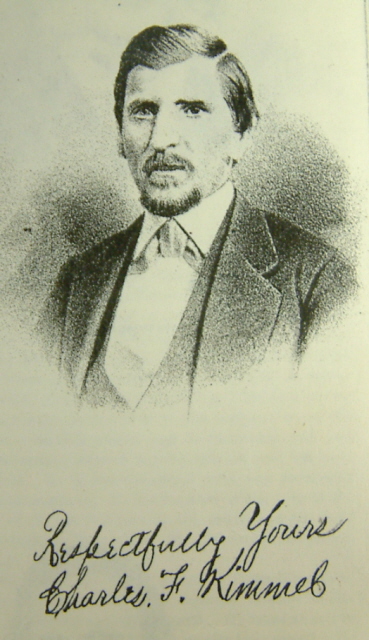
Louise Kimmel
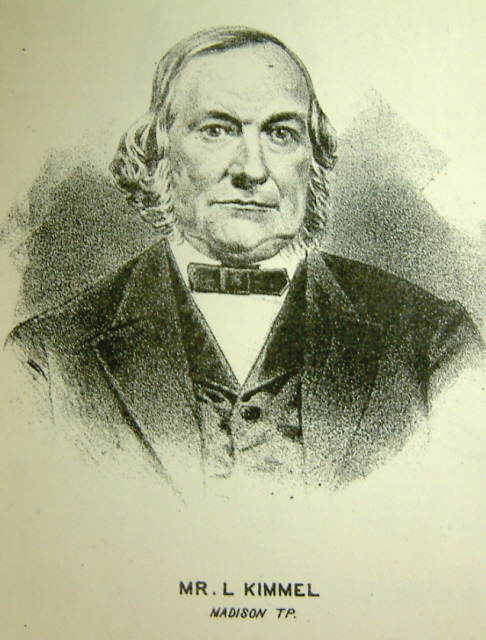
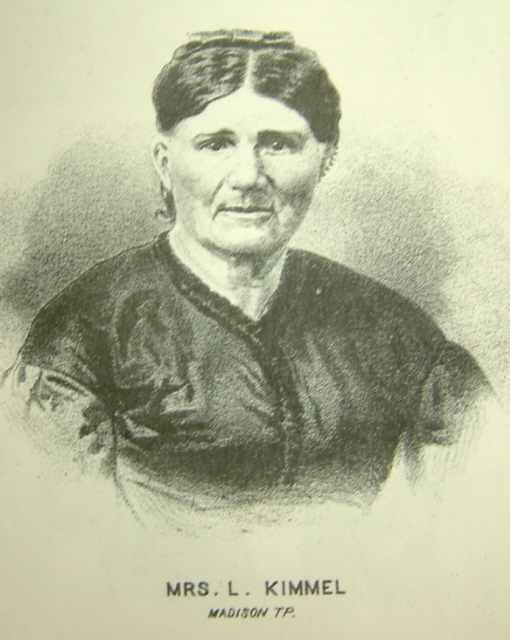
Mrs. Louis Kimmel
Charles F. Kimmel, son of Augustus B. and Johanna Louisa Kimmel, was born October 15, 1843, in Dayton, Ohio. His parents were poor and honest Germans, who emigrated to the United States from Altengottern, District of Erfurt, Prussia, in 1843, and settled in Dayton May 2, 1843. At the age of six years he entered the Fourth District School, and received a common school education. At the age of ten he was put to work driving cart. In September, 1860, he entered the grocery store of Mr. John F. Edgar as clerk. In the month of April, 1861, after the fall of Fort Sumter, he enlisted in Company B, "Lafayette Yagers," 1st Ohio Volunteer Infantry, Captain Peter Dister. Being rather small, and his parents objecting, he was sent back home. On the 23d of July, 1861, after the battle of Bull Run, he enlisted in Captain Crowe's Company F, 35th Indiana Volunteers, and was again disappointed by his father taking him home. He enlisted in Company B, 1st Ohio, Captain Louis Kuhlman, September 22, 1861. Again his parents objected to his going into the army. He then made up his mind to run away and join the army. About this time they were recruiting a company of sharp-shooters for General John C. Fremont's special service in Missouri, under Captain Calvin Reed. He enlisted October 1, 1861, and on the 5th left Dayton for St. Louis, Mo., arriving there on the 7th of October, and reporting to Captain B. D. Longstreath, at Benton Barracks, near St. Louis, was mustered in the United States service, November 23, 1861, by Lieutenant W. S. Bundy, U.S.A., in Company F. Birge's Western Sharp Shooters, Colonel John W. Birge commanding. On December 12, 1861, Colonel Birge marched the regiment from Benton Barracks to St. Louis, thence took the North Missouri Railroad for the field. Mr. Kimmel was engaged in the following battles and skirmishes.
[Reference two-page listing of dates, battles, and locations from December 13, 1861 through April 16, 1865.]
...April 26, 1865, surrender of General Joseph E. Johnston, C.S.A., to General William T. Sherman, U.S.A.; April 29, left Raleigh [North Carolina] on the homeward march, via Warrenton, Louisburg, Tarboro', and Gaston, N.C.; Petersburg, Manchester, Richmond, Hanover C.H., Nottaway C.H., Concord, Chancellorsville, Gordon, Fredericksburg, Spotsylvania C.H., Manassas, Occoquan, Dumfries, Mount Vernon, Alexandria, and Arlington, Va.; crossed the Potomac River on the Long Bridge, and arrived in Washington City, D.C., May 22, 1865; at the grand review of General U. S. Grant's Army of the Potomac, May 24; at review of General Sherman's Army of the Mississippi, two hundred thousand Union soldiers; June 3, 1865, left Washington City, via the Baltimore and Ohio Railroad, passing through Harper's Ferry, via Cumberland and Frederick City, Maryland, Piedmont, Clarksburg, Grafton, and Parkersburg, W.Va., thence down the Ohio River on steamer Star Light and Westmoreland to Louisville, Kentucky; mustered out of the U.S.A. July 7, 1865; discharged at Springfield, Illinois.
After the war, he took a seventeen months' cruise through "Dixie," stopping at the following places, viz.: Covington and Louisville, Kentucky; Memphis, Nashville, and Chattanooga, Tenn.' Atlanta and Augusta, Georgia; Branchville and Charleston, South Carolina; Pensacola, Florida; Montgomery and Mobile, Alabama; Corinth, Vicksburg, and Natchez, Miss.; Baton Rouge and New Orleans, La.; Napoleon and Helena, Ark.; St. Joseph and Hannibal, Mo.
In the fall of 1867, started for the far West, via Indianapolis and Lafayette, Indiana; Galesburg and Quincy, Illinois; Macon and Chillicothe, Mo., to Leavenworth, Kansas; thence, via Kansas Pacific Railroad, through Lawrence, Topeka, Manhattan, Saline City, and Hays City, Kansas, to Fort Hayes. At Fort Hayes started with an outfit for the Moreno Mines, at Elizabethtown, New Mexico; walked from Hayes, via Sante Fe trail, passed Fort Doge, Fort Aubrey, Kansas; Fort Lyon, Colorado, and Trinidad, N.M., to Maxwell's Ranch on the Cimarron River; worked seven months in the Moreno Mines, then, August 20, 1868, walked, via Pike's Peak, Pueblo, and Cherry Valley, to Denver City, Colorado; then, via Golden City, Blackhawk to Central City, Colorado; worked three months in Chase Gulch, Colorado; then walked via Denver, Burlington, and Long's Peak to Cheyenne, Decotah; went to work on the Union Pacific Railroad at Bryan City, Wyoming; Assistant Station Agent at Echo City, Utah; in the spring of 1869, he went to Salt Lake City, thence went East to New York on a visit, via Evanston, Wasatch, and Piedmont, Utah; Greenriver City, Fort Fred Steel, Laramie City, and Sherman, Wyoming. Then Sidney, North Platte, Fremont, and Omaha, Nebraska; Sioux City, Des Moines, and Davenport, Iowa; Rock Island, Sheffield, Joliet, and Chicgao, Illinois; Michigan City and South Bend, Indiana; White Pigeon and Adrian, Michigan; Toledo, Cleveland, and Painesville, Ohio; Erie, Pa.; Dunkirk, Dayton, Salamanca, Binghamton, and Hornellsville, New York; Paterson and Jersey City, New Jersey; spent two weeks in the Empire City of America. Thence to Dayton, Ohio, via the N.Y.C.R.R., through Albany, Syracuse, Rochester, Buffalo, and Dunkirk, New York, to Cleveland; thence to Crestline, Mansfield, Wooster, Canton, Alliance, and Massillon, Ohio; Manchester, Beaver Falls, and Allegheny City, Pa., to Pittsburg, on a seven days' sojourn in the Iron City; thence via Steubenville, Delaware, and Columbus, Ohio, to Dayton; thence via Troy, Piqua, Sidney, Lima, and Delphos, Ohio; Fort Wayne and Valparaiso, Indiana; Chicago, Dixon, and Fulton, Illinois; Clinton Cedar Rapids, and Council Bluffs, Iowa, thence via the U.P. and C.P. Railroad to Kelton, Utah; walked from Kelton to Boise City, Idaho, via Clear Creek, Mountain Meadows, and Snake River; thence Malad City to Boise City. Then walked to Walla Walla, Washington Territory, via Payette Station and Weiser Ranch, Burnt River, La Grande, Oro Dell, Union, and Baker City, Oregon, to Walla Walla, W.T. Then through Wallula, Umatilla, Celilo, Dallas City, Oregon, to Cascade City, W.T., General Sheridan's battle-ground in 1855; then to Fort Vancouver to Portland, Oregon; remained in the Webfoot country one year; then took the steamship Oriflamme to San Francisco, California; thence to Sacramento, Vallejo, Benicia, Rio Vista, Sancelito, Petaluma, and Roseville, California. Thence homeward via the C.P. and U.P.R.R., C. and N.W.R.R., P., Ft. W. and C.R.R., and Dayton and Michigan R.R., arriving at Dayton, Ohio, on the 27th of November, 1870; settled in Dayton. While in Colorado, was in the Indian fights at White Pass, N.M., June 17, 1868; Big Timbers, Colorado, August 28, 1868, and Kiowa Creek, Colorado, August 29, 1868. He crossed the American Plans, Great American Desert, and Rocky Mountains six different times, and traveled in all sixty-five thousand three hundred and forty-five miles,--on water, twenty-one thousand; on foot, sixteen thousand three hundred and ninety five; on cars, thirty-eight thousand nine hundred and fifty. Was married September 26, 1871, to Miss Kate Ann Stephens, the accomplished daughter of John G. Stephens, of Greenville, Ohio.
Joseph B. Kindle
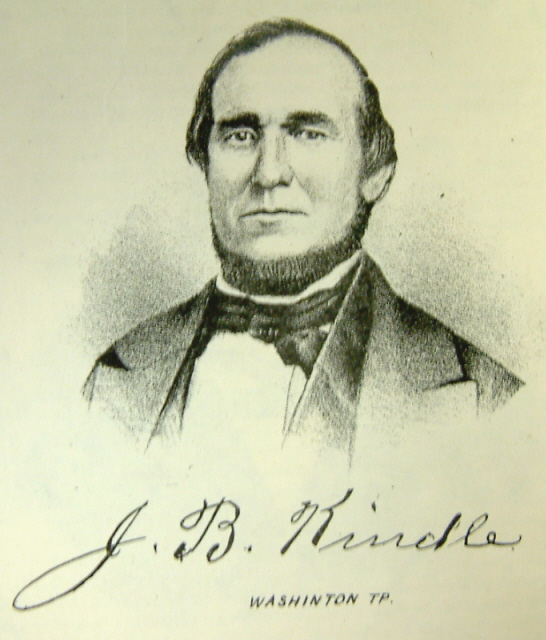
Washington [Township]
Joseph B. Kindle was born on the 10th day of February, 1816, in Burlington County, N. J. His parents were William Kindle and Hope Wilkins. They were both natives of New Jersey, and farmers by occupation. At the age of twenty, Joseph, with an education acquired by his own exertions, began life as a blacksmith, in Waynesville, Ohio. This occupation he has steadily followed ever since. In the spring of 1836 he visited Montgomery County, but did not settle permanently till 1842, in Washington Township. During his residence in Washington Township, he has always been known as a man of integrity and usefulness. He has been elected Magistrate for twenty-one years. He has also held other offices of a township character. He is now (1874) Master of the Washington Grange of Patrons of Husbandry, also Overseer of the County Council. He was married on the 28th of March, 1839, to Margaret Sheehan, a native of Pennsylvania. She died in September, 1850, having had five children. On the 18th day of November, 1852, he was married to Julia A. Thomas, a native of Ohio, and a daughter of Edward and Abigail Thomas, whose family name was Benham, a name that figures prominently in the early history of this State. The Squire is a Republican of liberal views. In society he is affiable and attentive, is a man of mild but determined manner, and is much respected for his public spirit and integrity.
Philip Klopfer
Dayton City
This gentleman, who is an enterprising and courteous clothing merchant of this city, is the son of David and Fanny Klopfer, and was born in dear old Funderland; the place, Buttenwiesen, five miles from Augsburg, Bavaria, Germany; the time, May 22, 1835. Until the age of thirteen years, Mr. Klopfer had the advantages of superior education; but at this era in his life he was apprenticed to the baker and confectionery business in Krumbach, Bavaria, for which privilege his father paid the sum of one hundred dollars; our subject pursued this avocation four years. After the expiration of that time he followed the business for one year. When eighteen years of age he was induced, by his brother Morris, of Cincinnati, to emigrate to American, indorsing this inducement by furnishing one hundred dollars. Consequently, on the 26th December, 1853, Mr. Klopfer bade adieu to his native land, and stated on his transatlantic pilgrimage. From the city of Antwerp, in Belgium, he took passage on an old-fashioned sailing vessel christened Vasco de Gama, and after a perilous voyage of one hundred and nineteen days, he landed at the dock in New York. He stayed half a day in the metropolis, and from there journeyed to Pittsburg; from there to Cincinnati by steamer, which was fourteen days making the passage. When arrived at his destination, Mr. Klopfer had seven cents in his pockets; this was on the 3d July, 1854. He remained in his impecunious state a few days, and then commenced peddling with a stock of notions, first coat, twenty-eight dollars; this amount the firm of Louis, Stix & Co., trusted him with. He was out three weeks, and realized ninety-seven dollars, and had a good portion of his goods left. He went back to Cincinnati, paid up all indebtedness, bought more goods, kept on peddling for six months afterwards, when he was independent enough to send twenty-five dollars to his father and mother in Germany,--a practice which he has exercised four times a year as long as the old folks lived. Fortune was favoring him, and he bought a horse, for which he gave thirdy-five dollars; but this horse was so very poor that he ws almost obliged to carry both horse and goods on his back. Six months passed away, and he bought a second and much better horse. Thus having two horses and a wagon, he continued peddling in the Counties of Warren, Greene, and Montgomery until the fall of 1858, when he opened a small clothing store in the Ohio Block on Third Street, Dayton City. In this place he remained eight months, and then removed to his present place of business, viz.: "The Original One-Price Clothing-House," No. 11 East Third Street, Dayton, Ohio. In 1866 Mr. Klopfer withdrew from business and sold out to J. P. Strauss & Brother, of Cincinnati. After four years' speculation in cotton, whisky, hots, and tobacco, in which he was not quite so successful as in the clothing business, in 1870 he bought one-half the interest in his former occupation, and he is at present prosecuting the wholesale and retail clothing business at the stand above mentioned.
On the 5th May, 1858, he married Miss Esther Weinstein, of Cincinnati; result of this union, six children, four of whom are still living. Messrs. Klopfer & Strauss keep a splendid assortment of ready-made clothing of their own manufacture; also a great variety of home and imported cloths for gentlemen's wear; in fact, anything in the line may be found at this popular "house," at the lowest living profit price. It is indeed the "Original one-price clothing-house" of the city.
Major Jefferson T. Kuns
Madison [Township]
Among Madison's young and enterprising men may be placed the name of Major Kuns, a native of this town, who was born March 19, 1837. His grandfather, Jacob, was one of the earliest pioneers, coming here in the year 1804, from Pennsylvania.
Our subject's father was also born here, February 8, 1815. His mother was born in Woodstock, Virginia, April 15, 1813. They had four children, three of whom lived to see manhood, of whom J. T. is the eldest. The Major is possessed of good practical knowledge. His time has chiefly been devoted to farm-labor; however, six years of his life were passed in mercantile pursuits. On the 13th day of May 1858, he was united in marriage with Miss Eliza Ann Olinger, who was born August 30, 1836. She is a daughter of Judge Olinger, of Jefferson Township. Five children were born, three boys and two girls, viz, Sarah M., Jesse P., Agnes A., George J., and Clarence D. In politics, Major Kuns is a Democrat. He has held several offices of trust in the Township, of which he is a worthy and respected citizen. He was Township Clerk, Trustee, and Justice of the Peace. At present he is President of the School Board. During the terrific Rebellion he was chosen Major of the 3d Regiment of Montgomery County Militia, receiving his commission from Governor Todd. He is at present a member of the Madison Grange, No. 206, and is Secretary of the same. He is living on the old homestead where his father has passed many a weary day. Major Kuns owns some one hundred and ninety-nine acres of land five miles north-west of Dayton, on the Dayton and Lexington Road. He is still a young man, being thirty-seven years old; and he still bids fair for years of usefulness.
L
Henry H. Laubach
Henry H. Laubach, born in Pennsylvania and residing in Dayton
Samuel Liggett
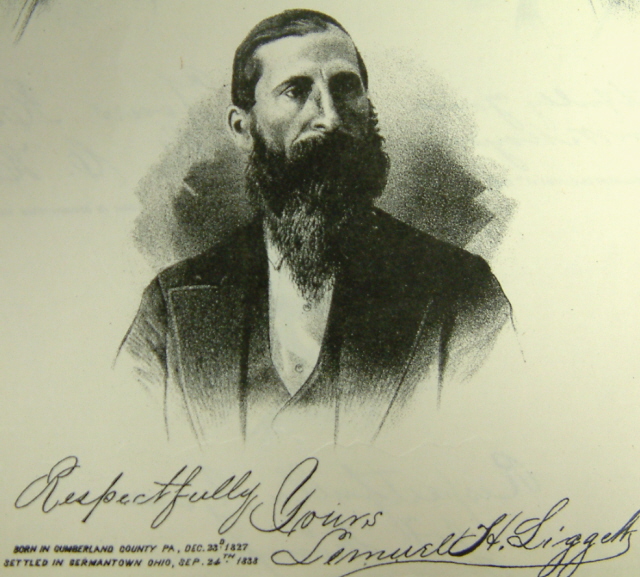
German [Township]
Son of Elias and Eleanor Liggett, born Dec. 23, 1827, in Cumberland County, Pa. He moved with his father to Sunbury, Montgomery County, Ohio, in the year 1838. Considering the incipient stage of education at that time, he received a liberal share by attending the Germantown Academy. He finished his education when eighteen years of age, and, after this, assisted his father in his various enterprises until the year 1850, when he entered into partnership with his father. The sire and son opened a dry-goods store in Germantown, occupying a rented building until they erected one for themselves, in which place Mr. Liggett is at present doing business with his brother, an M.D.; a view of this place can be seen by referring to another page. [Referring to another page in Everts 1875 Combination Atlas Map.] On the 20th of February, 1850, Mr. Liggett married Grace, daughter of George W. and Elizabeth Schoeffer, of Germantown; four children have been born to them; one died when two years old. Mr. Liggett is a strong supporter of the Democratic party, but entertains no malice to those who are pleased to differ with him; a more genial gentleman is not easily found. Mr. Liggett is a man of culture, and is highly respected by his fellow-townsmen, as being one of the thorough-going business-men of Germantown.
Elias Liggett
German [Township]
This gentleman is the son of James and Sarah Liggett, of Cumberland County, Pa., and was born December 9, 1802. When quite young, he learned the trade of blacksmith, with his father.
Arrived at the age of twenty-one, he united himself in marriage with Eleanor Sower, of Cumberland County, Pa., and the result from this alliance was five children, three of whom are living. Soon after marrying, he commenced business for himself. He removed to Sunbury, Montgomery County, Ohio, in 1838, and there opened a hotel. Mr. Liggett was engaged in various kinds of business, until he finally engaged in the mercantile trade in Germantown, about the year 1850. In this business he continued until his death, which occurred on the 10th of August, 1870. Mr. Liggett had the confidence and esteem of his neighbors; he was a man of sterling character, and was well known as one of the staunch men of business in Germantown. He established a successful and popular business house, which is now in operation under the name of "Liggett & Brothers."
Mr. Liggett was a member of the Masonic Order, a sound Democrat, and one who took an active part in the politics of this country.
M
Peter Moyer
Miami [Township]
Henry and Elizabeth Moyer, the parents of the gentleman of whom we now write, came to Miami Township in the year 1804. Peter Moyer was born in Berks County, Pennsylvania, September 7, 1789.
The family settled on the place where the present Mr. Moyer lives, and where his father faithfully labored and ultimately died. Old Mr. Moyer died before a year had passed from the time he came here. The family, after this sad event, moved to another farm, in sight of the place where the subject of this sketch at present resides, and, be it remembered, where his kind and affectionate mother died. Mr. Moyer attended a German school in Pennsylvania, and when he came to Ohio he went to an English school. But these opportunities of going to school were only offered in the winter season; all through the long summer-time he was hard at work, and in a great measure forgetting what he had learned; his advantages, therefore, were very slender, and his education consequently limited.
The 8th of October, 1812, he was united in marriage to Elizabeth, daugther of Mr. Heck, of Jefferson Township.
The result of this union was ten children, five of whom are now living. His companion was called to her heavenly home October 28, 1856. He lost an affectionate and devoted wife, and his children a kind and gentle mother. She was a member of the Lutheran Church and a Christian lady. Mr. Moyer was formerly a Whig; now a Republican. He is a member of the Dutch Baptist Church; a man who is widely known as the oldest pioneer living in the Township.
George W. Mumma
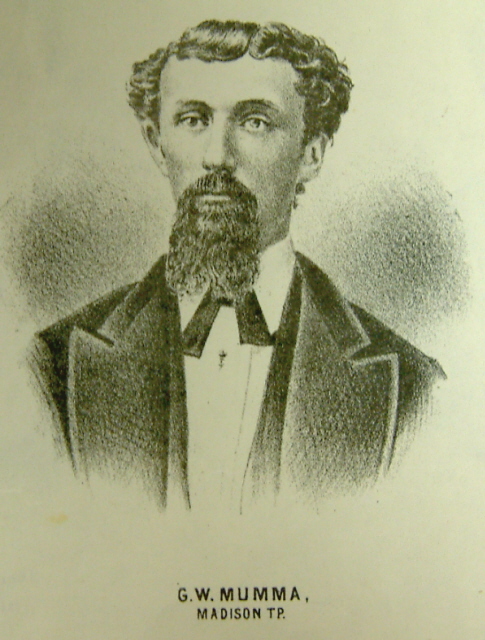
Madison [Township]
The gentleman whose name graces the head of this biography was born August 22, 1846, and is the son of Jacob H. and Susan Mumma.
He was reared on a farm, and he yet pursues that honorable calling. His educational advantages were limited, but by perserverance and self-study he has acquired a good practical education.
In politics he is a Republican, and is in favor of good schools. On the 20th of August, 1874, he, in company with his brother Aaron, purchased the old "homestead," of one hundred and sixty-seven acres, which is located three and one-half miles northwest from Dayton. On another page of this work may be soon a fine view of Mr. Mumma's premise; his farm is well watered and timbered. Two fine portraits, one of himself, and one of his lady, may also be seen.
George R. Mumma
Harrison [Township]
Jacob Mumma, father of George R. Mumma, was born October, 1792, in Lancaster County, Pa. At the age of four he moved with his father to Maryland. He was a apprentice for six years at the weavers' trade; at the age of twenty-two married Miss Mary M. Blessing, of Frederick County, Md., and as a result of said alliance, nine children have been born to them. He continued his trade for more than thirty years. In 1827 he moved to Dayton, Ohio; was twenty-five days on the way; bought a small farm of fifty-three acres, situated three miles northwest of Dayton, for three hundred and fourteen dollars. He followed farming and attending market till within two years of his death; died at the age of seventy-seven. Mary M., his wife, daughter of Philip Blessing, was born in Frederick County, Md. She was one of the most thorough of women in all the details of house work, and as a tender-hearted and affectionate mother none surpass her. She is still living with one of her daughters, two miles from Dayton. She is seventy-nine years of age.
George R. Mumma, eldest son of a family of nine children, was born in Frederick County, Md., December 5, 1819; came to this State with his father in 1827, and settled at or near Dayton. His father being a weaver by trade, young George was reared in all the details of that business, working at it for some eight years from early morn until late at night, during which time he attended market, which he continued to follow for twelve years afterwards. He would be at the market by twelve o'clock at night, and at home for breakfast early in the morning. He attended school in an old "Pioneer School-House" from three to four months each winter. He applied himself studiously, and after he was of age he taught school for five successive winters at the rate of sixty dollars for sixty-five days' schooling, boarding himself out of said funds. Worked for his father on the old farm for fifty dollars during the summer and fall; thus he commenced life, and to-day, by close application to business, strict integrity, and sound judgment, he is well off.
In a few years he went into partnership with Andrew Heiks in the nursery business. The second year he bought out his partner, hired help, kept bachelor's-hall for two years. At the age of thirty-four years he was married to Miss Mary A. Drake, of Clinton County, Ohio, daughter of Benjamin and Lovina Drake. Mary is one of a family of eleven children, and is a lovely and devoted wife. George, being thus surrounded by such happy influences, was able to extend his now growing and prosperous business, till at length he stands among the most prominent in the land. He has, at the present time, a beautiful home about one and a half miles from Dayton, northwest, a fine view of which, besides portraits of himself and wife, may be seen elsewhere. He keeps a strict account of all moneys received and paid out, and to-day he pays next to the highest government tax of any one in this Township.
Mr. Mumma is the happy father of six children, two of whom died in infancy. He is a worthy and esteemed member of the Evangelical Luthern Church, which he joined at the age of twenty-four. But few can truly say that he never missed a communion service since a member, but Mr. M. can.
He is not only a supporter of the preached Word, but the Sabbath-school finds in him one of its strongest supporters; besides, our common schools are well supported by him.