


Simon Gebhart Family Reunion
Dayton Daily News - January 2, 1889
Family Dinner Party
[transcription of article]
Mr. and Mrs. Simon Gebhart and their entire family of children and grandchildren at dinner at their home yesterday--a family of twenty-two--George P. and wife and children, Robert, Edgar and Rollin; Wm. F. and wife and children, Percy, Dick and Louise; Capt. R. Norwood, U.S. A., and wife and children, Mary and Sonerfield; W. B. Gebhart and wife; O. B. Brown and wife and two unmarried daughters, Mary A. and Florence; Miss Anna Parker, a niece of Somerset, Pa., was also present. This was a complete family circle without a break. All the children of Mr. and Mrs. Gebhart and all the grandchildren were present. A remarkable instance of a large and happy family without a single one absent or deceased. Mr. and Mrs. Gebhart were married about fifty years ago. The oldest grandchild is twenty-two years and the youngest three years of age.
The Hill Reunion
Dayton Daily News - June 10, 1904, Pg 3
THE HILL REUNION
Members of Family Gather from Ohio and Indiana
[transcription of article]
An event of more than the usual family interest was the reunion of the Hill families of Ohio and Indiana on Thursday afternoon at the fair grounds, when nearly one hundred representatives were assembled to enjoy their annual festival. The president of this society, W. H. Hill of Cincinnati, made the address of welcome, while the guests were seated at the dinner table, which was sumptuously appointed. At the conclusion of the dinner the formal program was inaugurated, and included the reading of the history of the Hill clan, which was most interestingly given by Miss Garnet Hill of Mount Healthy, and an original poem was read by Wilson Hill of Indiana. A pretty song was given by two daughters of Mr. and Mrs. Hill of Mount Healthy.
An event of particular interst just at this time was the wedding of Mr. John A. Hill, the son of the president, to Miss Victoria Carey of Sidney, which was solemnized at Sidney, Thursday, and many of those attending the reuniion will go to Piqua, Friday, to attend the reception given in their honor.
There were five generations present on this occasion of the fifth reunion, Mrs. Rebecca Hill McFeely of Union City, Ind., aged 88 years, being a guest of special honor, and she shared the attentions with her great-great-grandson, the baby of Mr. and Mrs. Benjamin Hill of Cincinnati.
After a day of general enjoyment, exchanging reminiscences and happy greetings, the election of officers occurred, resulting in the re-election of the following: Willis Hill of Piqua, president; Miss Mary Hill of Mount Healthy, vice president; Mrs. Lida McGuffey of Conover, secretary, and James Coddington of Conover, treasurer.
The committee on program includes Mary Hill of Conover, Nora Hill of Piqua and Wilson Hill of Indianapolis, Mr. and Mrs. C. T. Hill of this city will make up the committee on arrangements for the next annual reunion.
Tobey Family Reunion
Dayton Daily News - September 2, 1905, Page 5
A Family Reunion
[transcription of article]
Michael Tobey came from Maryland in 1836, with his family of 6 sons and four daughters, where most of them grew to manhood and womanhood, all living to a good ripe age, except one daughter, Mrs. Barbara Buzzard, who died in early womanhood. His wife died in 1857 in Dayton, Ohio, and he in 1872, in Mattoon, Ill. His children with their families settled at different places in the central states of Ohio, Indiana and Illinois. As they would get together occasionally they talked much of a reunion of all the family and its different branches; but deferred it from year to year until all were gathered home.
The last one taken was Nathaniel, the youngest son, of Troy, O., in November, 1903, and it remained for his son, Chas. W. Tobey, to bring to pass the event so long a dream of the fathers. The first was held at Crystal Springs on his farm near Troy, Ohio, September 8, 1904, and for the time given for preparation was so much of a success that a decision to repeat it was unanimous. Letters were sent to members of the different branches of the family, which is now carried down to the third and fourth generation.
They were found to be scattered throughout different states from Rhode Island to California, and as variously occupied with different trades and professions. August 24th was the day set for the meeting this year and at the same place as before. The day dawned bright and clear, but with the mercury climbing to the tip top figures, which it soon reached and played about them for the rest of the day. The heat under different circumstances would have been beyond endurance, but the cool shady retreat almost hidden away from the sun with an abundance of cold spring water gushing out of the hillside and winding over rocks and stones to a fall below, seemed to hold you spellbound as if in some enchanted bit of Fairyland.
But the day was not meant for dreaming. Friends old and new to meet and much to learn of each other in this large company of relatives.
The number was not so great as had been hoped, the great distance and the busy lives of many preventing their attendance.
But over 40, of all ages from over fourscore years down to the babe of one year old met and spent the day together.
We found Charles and wife, with a brother-in-law, Mr. Gibbs and wife, most royal entertainers and everything possible was done for the comfort and enjoyment of all present.
Language fails to do justice to the dinner and supper with which the tables groaned until their contents were transferred to other receptacles from which groans were to be heard very distinctly.
Of Eliza Geeting, the oldest sister's family, were present a grandson, Perry Rankin and his wife, of Vandalia, O. Of Johnathan Tobey's family a daughter, Mrs. Elisa Dayton and son, Rowland, and daughter Helen, also Mr. and Mrs. Abbot and their little daughter, Rachel, all of Newark, O. Of Michael Tobey's family none were present. Of Henry Tobey's family two sons, Richard and wife, Orion and wife, the latter's son Wilbur and daughter Minnie, Mr. and Mrs. Gilbert Davis, a daughter-in-law, Mrs. Wm. Davis and son Wilbur. Of Susan Harry's family none were present. Of Sophia Tobey Hull's family her husband, Adam Hull and daughter, Nora, Mr. and Mrs. T. H. Mumma and their son, Chas. and wife, of Columbus, O. Mr. and Mrs. Elva Haller and son Lester, Mrs. Chas. Wachter and children, Mildred and Frank, all of Dayton, except Chas. Mumma and wife. Mr. and Mrs. Perry King and daughter, Rena. Mrs. King being a granddaughter of Henry Tobey, their home being Pyrmont, O. Of Robert Tobey's family none were present.
Of Reuben Tobey's his wife, Mrs. N. M. Tobey. Of Nathaniel Tobey's, his son, Charles and wife, of Troy, O., also Mrs. M. E. Gritt, a cousin of Union City, Ind. Other friends were: Mr. and Mrs. Gibbs, Dr. Thompson and brother, of Troy, and Miss Ruth Salts and Miss Ethel Keller, of Dayton, O.; and Master Howard Bish, also of Dayton.
Among other things of interest shown there that day was a German Bible printed in 1534, and handed down in this family from father to son to the third generation, the intention being to keep it in the hands of one who will retain the family name. At this meeting Rev. Frank Tobey, of Westfield, Ill., was made president of the Association, the next meeting to be held at or near Dayton, O. The afternoon was spent very pleasantly in social intercourse, many reminiscences of the past were called up, touching allusions were made to the memory of the departed and the day seemed all too short when approaching nightfall called for separation. All left feeling it was a day well spent and anxious for its return another year.
Many Out-Of-Town Relatives at Ressler Reunion
Dayton Daily News - September 11, 1921
Page 10
Many Out-Of-Town Relatives at Ressler Reunion
Original picture from article.
[transcription of article]
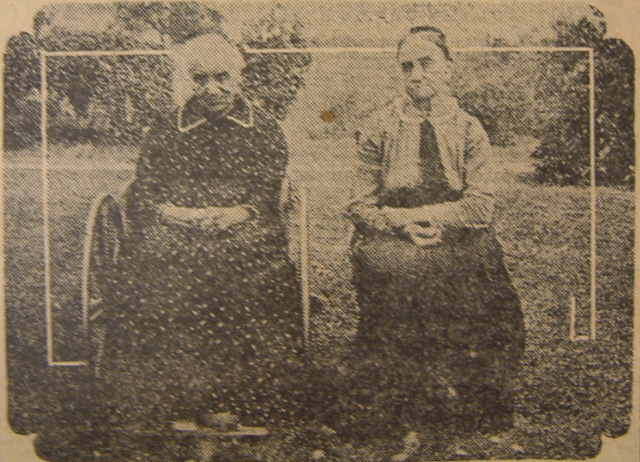
MIAMISBURG, O., Sept. 10 - The reunion of the Ressler family, organized into an annual institution, centers about the two sisters pictured here. These are Miss Minnie Ressler and Mrs. Amelia Watson, only surviving members of the large family of Michael Ressler, whose descendants now celebrate their kinship each year. Both sisters were born on the old Ressler homestead at the eastern edge of Miamisburg and have been lifelong and well known residents of this community.
Their family reunion last Sunday was the third annual affair and was held, as it has been on preceding occasions, at the Urias Gebhart home south of Miamisburg. Ninety-two guests dined at the tables that were given a beautiful outdoor setting. A program in the afternoon included the recounting of family history by Attorney Mahlon Gebhart, and a narrative of personal experiences in Germany by Charles Myers of Indianapolis. Election of officers resulted in returning to office the following: President, Charles Ressler; secretary, Miss Amelia Gebhart; treasurer, Mrs. A. B. Wertz; historian, Attorney Mahlon Gebhart.
A list of out-of-town relatives present includes: Mr. and Mrs. Harry Bode, Mrs. Cora Bode and daughter Corrine, Mr. and Mrs. W. H. Ressler, of Cincinnati; James Dana and his daughter Ruth, and Mrs. Carrie Guepe of Fondulac, Wis.; Mr. and Mrs. Chas. R. Myers, Mr. and Mrs. Ed Myers, Mr. and Mrs. Charles Myers, Jr. and daughter Ruth, Frank Myers, Miss Anna Myers, Mr. and Mrs. John Myers and their children John and Willa, Mr. and Mrs. Harry Myers and son Robert, Mrs. Rose Montgomery, Miss Anna Frauer, Mrs. Julia Christina, Mr. and Mrs. Jack Twinam and children Walter and Clara, of Indianapolis, Ind., Mrs. Herbert Zapp and daughter Catherine of Louisville, Ky., Mr. and Mrs. Peter Lesher, Mr. and Mrs. Dietz, Mr. and Mrs. Harry Lesher, Mr. and Mrs. Vernon Lesher and son of Dayton, O., Mr. and Mrs. A. R. Wertz and son Richard, Mr. and Mrs. Edward Drayer and son Edward of Middletown, O.
Ewing Reunion
Dayton Daily News - August 29, 1902, Page 9
Ewing Reunion
[transcription of article]
The thirteenth annual reunion of the Ewing family was held Thursday, August 25, at the residence of Mr. Arthur Davis near Tadmor. About 9 o'clock the guests began to pour in from the surrounding country and continued to do so until noon. Those who went from Dayton and Troy were met at the traction and conveyed to the Davis homestead in hay wagons, etc. The morning was delightfully spent in reviewing old acquaintances, for many meet only at these reunions. Handshaking introductions and reminiscences occupied the time and the noon hour came only too soon for many. But their reluctance was somewhat overcome at the sight of the tables which were groaning under the weight of the good things placed on them. Around the tables were sated 104 guests. About 2 o'clock the association was called to order by the president, Mr. John Ewing, and an interesting program was rendered.
Song; Scripture reading by the president; prayer, by Rev. Chas. E. Ewing; report of the secretary; song, "Sweet Hour of Prayer"; report of treasurer.
The election of officers resulted in retaining all the former officers, namely: President, Mr. John Ewing; vice president, Mr. Robert Ewing; secretary, Miss Stella Ewing; treasurer, Mr. Joseph Ewing.
Report of committee on resolutions; solo, by Miss Stella Ewing; greetings were read from Dr. U. V. G. Ewing of Richmond, Ind., and Miss Ethel Lodge of Hagler, Ark.; articles were read announcing the deaths of Mrs. John Elliott of Greensburg, Ind. and Mr. Samuel Ewing of Wabash, Ind.; address, by Rev. Sollenbarger; song, "God Be With You Till We Meet Again"; the invitation extended the association by Mr. E. Folkerth to meet at his home near Troy, was accepted; prayer.
Thus ended one of the most delightful meetings of the Ewing family. It is needless to say that all who were so fortunate as to attend this reunion will put forth great efforts to be present next year.
Mrs. B. F. Davis and Daughter Audrey Ruth
Dayton Daily News - May 1, 1935, Page 20
Mrs. B. F. Davis and Daughter Audrey Ruth
Original picture from article.
[transcription of article]
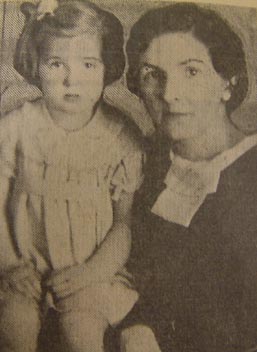
Mrs. B. F. Davis of Cleveland is shown with her daughter, Audrey Ruth. Mrs. Davis formerly lived in this city [Dayton] and was before her marriage Miss Ruth Williams. Mrs. Davis and daughter have been visiting the former's aunt, Mrs. Andy Heldoerfer of Wilfred av.
How The Brown Family Got to Dayton (1935)
Dayton Daily News - November 3, 1935
How The Brown Family Got to Dayton by Howard Burba
A history of Henry Brown, from Lexington, Virginia to Dayton, Ohio in 1793.
A history of Thomas Brown, from Manahawken, New Jersey to Dayton, Ohio in 1828.
[transcription of article]
If you happen to belong to that grand old clan bearing the family name of Brown you have far more to be proud of than the mere fact that there is a prominent street in Dayton named for you.
You have to cite another honor, the distinction of knowing that your family name figured in local affairs long before there was a town here in which to christen a street by that name. There was a member of the Brown family doing a thriving business with the Indians and first settlers of this section of the Northwest Territory quite a while before John Cleves Symmes had disposed of the site upon which the town of Dayton stands, and before Daniel Cooper came along to lay off that site into building lots.
Not all the Browns who now make this garden spot of the world their abiding place can trace a direct lineage, of course, to old Henry Brown, rough-fisted and substantial pioneer, whose vision of a great new empire west of the Alleghenies brought him to these parts from the state of Virginia in the year 1793. But many of them can, and a lot of the oldest families of Browns do, and with a full measure of pride. For Henry Brown was the first of the good old family name to take up citizenship within the then new settlement of Dayton. It was the descendants of his three children born in the original Brown homestead near where the present Steele high school stands, who carried the family line down through the years to the present day. If you can trace your ancestry back to Henry Brown then, indeed, you have far more to be proud of than the mere fact that there is a street in Dayton bearing your family name.
Henry Brown's ancestors were Scotch-Irish Presbyterians, who emigrated to this country from the north of Ireland about the year 1740 and settled in "Burden's Grant," which included half a million acres of land on the Shenandoah and James rivers, in Virginia.
Henry Brown was born near Lexington, Va., about the year 1770, and lived there until 1793, at which time he came to the Northwest Territory as military secretary for Col. Preston, who was in command of a regiment in Wayne's army, then being organized at Cincinnati for an advance against the Indian tribe. Mr. Brown was afterward interested with others in forwarding supplies to the army and to the garrisons at forts Hamilton, St. Clair, Greenville, Jefferson, Recovery, Defiance and Wayne.
From the nature of the roads and the difficulties and dangers of the service, all supplies were forwarded by pack-horse trains. This department was in charge of an officer who was designated as "Pack-horse Master General." The trains were divided into pack-horse brigades of 60 to 75 horses each, with a captain in charge and men to load and unload and care for the horses. Armed guards necessarily accompanied these pack-horse brigades as guards against Indian attacks. Mr. Brown was thus employed with the army until the spring of 1795, when he entered into partnership with John Sutherland at Hamilton, their business being trading with the Indians. They erected a log cabin storehouse just south of the historic stockade, now marked by a monument on Hamilton's main street.
Friendly tribes at that time occupied most of the country west of Wayne's road to the Maumee as hunting grounds. Their camps were to be found along all of the streams from Hamilton north to the Wabash and Maumee. This firm traded goods to the Indians for furs and pelts and when white settlers began to locate on lands west of the Miami, the Indians gradually withdrew to the north. But Sutherland and Brown followed them up with agents who carried goods from point to point on pack-horses.
In 1799 Mr. Brown took a large stock of goods to Fort Loramie and opened a branch store there, from which he sent traders to the Indian villages along the Wabash and Maumee rivers.
In 1804 business had so changed that he moved his branch store to Dayton and opened on the east side of Main st. just south of Monument, then shown on the town plat as "Water st." It was the beginning of the original Brown family in Dayton.
From this little store traders were sent with goods among the settlers west and north and to the Indian villages at Greenville and beyond to the Mississinawa and around St. Marys and the Auglaize and down through the Maumee valley. A trader would start with two or three pack-horses loaded with goods and often in order to dispose of them took extraordinary risks incident to the long, lonely trips through the wilderness. Sometimes they would be absent months at a time, never returning until their stocks had been completely disposed of. Then their pack-horses would be loaded with furs and pelts which they brought back to Dayton and from here they were marketed at Cincinnati and as far south as New Orleans.
At their stores in Dayton and Hamilton the firm of Sutherland and Brown exchanged much of their goods for whisky, flour, pork and grain, which they shipped by river to Cincinnati and New Orleans. Produce was shipped down the Ohio in flat-bottom boats and on rafts. When the Miami river was low, cargoes were "lightered" over the river in dugouts--canoe-like vessels made from giant forest trees. Sometimes, to get the dugouts over, the crews would scrape out channels of sufficient width to float the boats, then having passed the riffle they would reload and float down to the next where the operation was repeated. A crew was sometimes detained at the shallowest riffles for several days and often a week's time would be lost in getting a fleet across.
For two or three years prior to the dissolution of the firm, Messrs. Sutherland and Brown were largely engaged in the purchase of cattle in the Miami valley and over in Kentucky. The cattle were driven north to Fort Loramie, across the portage to the Auglaize river, then down to the Maumee and thence to Detroit where there was ready sale to the government, to the Indians and to settlers.
"It is hard to realize the delays, perplexities and difficulties in business in that time," writes and early historian... "To purchase goods a merchant would travel on horseback from Dayton to Philadelphia. As far as the forks of the Muskingum the road was but a single bridle path through the dense forest, with not a house or settlement on the way. The traveler necessarily packed his provisions for that part of the trip and camped by the way, without shelter and regardless of unfavorable weather. Three months' time was generally required for the trip, purchase of stock and getting the goods delivered in Dayton.
"The goods were hauled in wagons over the rough roads from Philadelphia to Pittsburgh, a ton and a half being a good load for a five-horse team. From Pittsburgh the goods were shipped by river to Cincinnati and hauled from there overland to Dayton. When the water was at a favorable stage shipments could be made by pirogues up the Miami river."
To Henry Brown belongs the distinction of having built the first brick house in the village of Dayton. That house was erected in the year 1810, on Lot No. 10, the present site of the new courthouse.
The hostile intention of the Indians toward the United States began to develop in that same year, and from the increased danger to traders Messrs. Sutherland and Brown withdrew their agents and dissolved partnership. Mr. Brown removed his goods to the north room of his residence and continued business there. At that time, or possibly the next year, he was made government agent in charge of Indian supplies that were distributed under Indian Agent Col. John Johnson of Piqua.
On Feb 19, 1811, Henry Brown was married to Miss Kitty Patterson, a daughter of Col. Robert Patterson. The wedding was celebrated at her father's house on the Rubicon farm, adjoining the present site of the National Cash Register plant, the Rev. James Welsh officiating. Catherine, or "Kitty" Patterson as she was best known, was born at Lexington, Ky., March 17, 1793.
Three children were born to this union, the first additions to the original Brown family in Dayton. The eldest of these was R. P. Brown, born on Dec. 6, 1811 and married to Sarah Galloway at Xenia, O., on Oct. 31, 1837. This son died in Kansas City, Mo., on May 4, 1879.
The second child born to Mr. and Mrs. Henry Brown was christened for this father. Henry Brown, jr., was born Dec. 3, 1814, and married Sarah Belle Browning at Indianapolis on Feb. 7, 1837. He died in Dayton Nov. 25, 1878. His wife was born at West Union, O., on Feb. 18, 1819 and died in Dayton Oct. 15, 1858.
The youngest of the trio of children was Eliza J. Brown, born in Dayton Oct. 20, 1816. She married Charles Anderson on Sept. 16, 1835. Col. Anderson was a native Kentuckian, having been born at Louisville on June 1, 1814.
"The business life of Henry Brown," declares an early local historian, "was characterized by sound judgment, firmness and energy and having faith in the good judgment shown in the selection of the site at the mouth of Mad River as the future business center of the valley, he invested largely in Dayton property. When prosperity came to the little town of Dayton during the War of 1812, he was one of the most prominent and influential men of the community and was held in the highest esteem throughout his entire life. He urged the opening of roads to all neighboring settlements, was active in the interest of public improvements and all affairs looking to the public good. When in 1813 the increase of business made it desirable that a bank should be established in the town of Dayton, he aided in the organization of The Dayton Manufacturing Co., the town's first financial institution, and secured for it a considerable loan from the government.
"His wife was an amiable, modest woman, yet for almost 50 years was among the most active Christian workers in Dayton. In 1815, being sick in bed, a number of ladies met in her room and, with her help, organized the Female Bible and Charitable Society of Dayton. All through her life she was faithful to the good work thus begun.
From exposure suffered during his earlier years in the valley and afterward in the active management of the business with Mr. Sutherland, Mr. Brown's health was broken, so much so that toward the close of the year 1822 he was confined to his bed and, after a lingering illness, he died in the afternoon of May 9, 1825. He was buried the next day in the old graveyard on Fifth st., near Wilkinson. Mrs. Brown was married to Andrew Irwin, by whom she had one son, A. B. Irwin. Her second husband dying shortly after their marriage she was married for the third time, her last husband being H. G. Phillips, for years one of the leading merchants of Dayton. He died in 1859, and she passed away on Aug. 12, 1864.
Henry Brown had been living in Dayton about 24 years when still another Brown, unrelated save for a kindred feeling that here was the land of milk-and-honey of biblical forecast, took up his residence. This time it was Thomas Brown of New Jersey, and if you trace your relationship to his humble home in the then struggling village of Dayton you, too, are justified in any boasted pride of ancestry you may care to indulge in. Like Henry, the first pioneer to bear the name of Brown, Thomas, the later arrival, wrote his name high up on the scroll of worth-while civic achievement.
Thomas Brown came within less than six years of living out an entire century. Born in the village of Manahawken, N.J., on April 10, 1800, he lived to the ripe old age of 94 years and one month, passing away in Dayton in 1894. He was a worthy son of a worthy sire, his father, Capt. Samuel Brown, having served with honor through the Revolutionary War. As a boy in the little New Jersey town, Thomas Brown showed a fondness for anything mechanical or mathematical and when but 12 years of age he had completed his study of mathematics from arithmetic through trigonometry and measuration .
His indomitable pluck, which made for him so successful a standing in after life, was shown in his determination by walking all the way from Philadelphia to Lebanon, O. He worked around the latter village for awhile, moved to Xenia in 1825 and then, three years later, came to Dayton to make it his permanent home.
Thomas Brown was a carpenter-contractor, having learned that trade in his younger years in the east. Shortly after arriving here he became associated with the pioneer contractor of early days, Thomas Morrison and under his personal direction some of the city's most substantial business structures were erected.
Hard work, crowned by success won for him the respect and esteem of all citizens and in 1848 he was elected a member of the first school board in the city. His term of office expired in 1841 and he was then elected a member of the Ohio legislature. Later he was made director of Ohio prisons and still later a trustee of public works of the state of Ohio. That concluded his political service and in 1868 he purchased an interest in the firm of S. N. Brown and Son, of which his son was the leading spirit. He was chosen president of that concern, a position he held until his death on May 8, 1894.
In 1824 Thomas Brown was united in marriage to Sarah Groome Brown, the widow of his brother, John, and became the father of four children: Ellen, Samuel N., Charles R. and Caroline. It is the descendants of these children, scores of them now residing in this community, who can lay rightful heritage to a pioneer ancestry of which anyone may well be proud.
Thomas Brown, or "Uncle Tommie," as he became affectionately known to all and sundry in these parts, was a Federalist and followed the many changes in that organization until it became known as the Republican party. He was an ardent Republican and never missed a vote if he could possibly avoid doing so. Old and feeble as he was, he voted on May 1, 1894, exactly one week before he died, at a special congressional election. He was always proud of the distinction of having voted for 18 presidents.
He was a public-spirited citizen and the first man in Dayton to use natural gas. As long as there was an abundant flow the natural gas company had a pipe in front of his house, which he lighted every evening. It is also related of him that a few years before his death there was a report that the walls in the Symmes block, which had been newly erected, were out of plumb. Old as he was, he climbed up the scaffolding and, lying down on a scantling, he sighted down the wall and pronounced it perfect and such it was afterward found to be.
An odd coincidence in the death of "Uncle Tommie" Brown rests in the fact that he was exactly as old, to the very day, as was his wife when she died 10 years before. In his later years he often declared to relatives and friends that if he could live to be as old as his faithful wife was at her death, he could die content.
Fate granted him that favor. Fate, it seems, has always been kind to those who bear the name of Brown.
Robert Conway Family One of The First Catholic Families in Dayton
The Calvary Chronicle Newsletter - Spring 2005, Page 1
[transcription of article]
In the early 1800's a few Catholic people came through Dayton. Some helped clear the woods and others helped build the Erie Canal. However, there was one family that established themselves in Dayton and saw to it that Catholics had a respectable place to worship.
The Robert Conway family moved to Dayton in 1831 from Baltimore, Maryland and was known to be the first Catholic family in Dayton. Robert, a copper by trade, moved to Dayton with his wife, Sarah, and their nine children. It is believed the children were born prior to moving to Dayton.
Conway felt strongly about his religion. A year after moving to Dayton, Robert arranged to have a priest come to Dayton. The Rev. Edward T. Collins came to Dayton, lived in the Conway house and Robert Conway was even responsible for supporting him. Rev. Collins became the first resident clergy and stayed for about two years. Within a year or two several other Catholic families moved to Dayton. They had no place to worship except the Conway household.
After Rev. Collins left, the Cincinnati diocese sent several missionary priests to administer sacraments to Catholics scattered throughout Ohio. People came for miles to the Conway house on Spratt Street to worship. The Conway residence soon became too small to accommodate the Dayton Catholic Community. Services were moved to a small building on St. Clair Street which also housed a bakery.
In 1837 the small congregation was able to build a small, brick one-story church. This was the beginning of Emmanuel Church. Emmanuel was dedicated in November 1837 with Father Emanuel Thienpont as pastor.
The children of Robert and Sarah were Hannah, Mary, Elizabeth, Ellen, Catherine, Michael, Adam, Edward and Robert. None of the children except Robert married. He as well as his brother, Edward, became dentists. Mary was a housekeeper, Hannah and Betsy millineries, Ellen and Catherine seamstresses, and Michael a brewery worker. Robert, Sarah and their children are buried in Section 1. Although the exact date of Robert's death is unknown, it is believed to be about 1850, before Calvary Cemetery was established. He was first buried at St. Henry Cemetery and his body moved to Calvary on the Conway family plot.
Curtin Family - Five Generations
Dayton Daily News - August 18, 1946
Five Generations
Original picture from article.
[transcription of article]
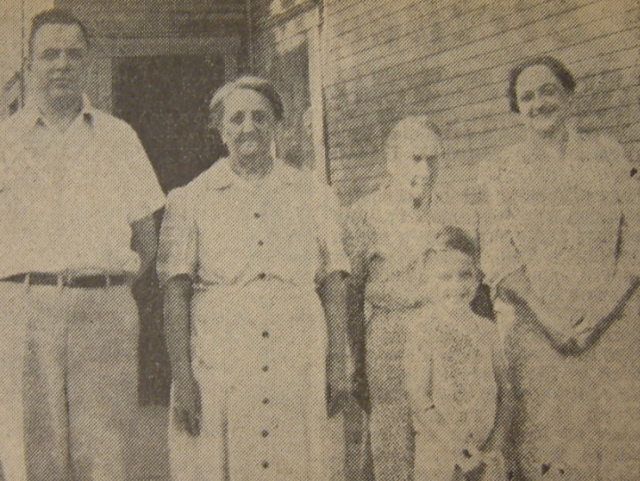
Six-year-old Ray D. Curtin Jr. of 23 Belle av. will celebrate his birthday Thursday and five generations of his family will be on hand. They are, left to right, his father, Ray, 28; great-grandmother, 65-year-old Mrs. Lucy Dafler of Lewisburg; his 90-year-old great-great-grandmother, Mrs. Emma Shaffer also of Lewisburg, and his 47-year-old grandmother, Mrs. Lena Curtin of Bellbrook.
Stewart Family Reunion
Dayton Daily News - August 3, 1946
Plane Ride Ends in Reunion of Relatives After 52 Years
Original picture from article.
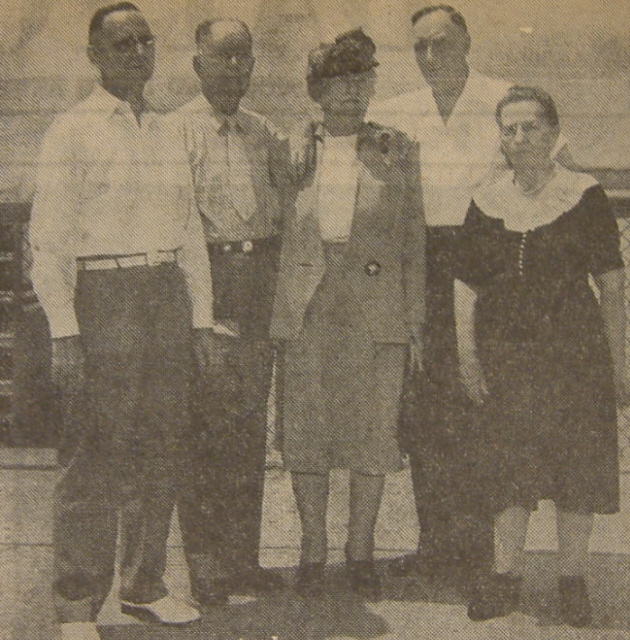
FAMILY REUNION - Mrs. Lillie Thomas Stewart, center, was greeted by brothers, stepbrother and stepmother at the Dayton Municipal airport Friday after a separation of 52 years. Left to right, Darrel Thomas, Arlington Thomas, Mrs. Stewart, Claude Thomas and Mrs. Rosa Thomas.
[transcription of article]
Fifty-two years after leaving Oxford, W. Va., for Camas, Wash., Mrs. Lillie Thomas Stewart, 76, was reunited with her relatives in Dayton, Friday.
The reunion took place at the Dayton Municipal airport. Mrs. Steward made the trip from Camas in a Trans World Airlines plane.
On hand to greet her were two brothers, Claude Thomas, 523 S. Jefferson st., and Arlington Thomas, 2229 Koehler av.; a half-brother, Darrell Thomas of N. Kilmer st., and her stepmother, Mrs. Rosa Thomas who journeyed from Oxford for the occasion. Another half brother, Alton Thomas who also lives in Dayton, was not present. All were former residents of Oxford who have moved to ayton in the intervening years.
Mrs. Stewart parted from her family in West Virginia in 1894 to journey by rail to Portland, Ore., where she made her home until a few years ago. Camas lies just across the river from Portland.
Her first visit to Dayton was preceded by her first plane ride which she said she enjoyed immensely. "It was no trouble at all," she remarked.
Although Mrs. Stewart did not recognize the other members of the family right away, they all knew her at first glance.
After spending some time in Dayton Mrs. Stewart will continue on to Pennsylvania to visit her sister.
Morton Family In Annual Reunion
Dayton Daily News - Sunday, August 4, 1946
Morton Family In Annual Reunion
Mr. and Mrs. Penn A. Morton - 50th Anniversary
[transcription of article]
Renewing the annual family reunion which had been interrupted by the war, 65 members of the Morton family, coming from five states, assembled at Lebanon last Sunday for the event, which also marked the 50th wedding anniversary of Mr. and Mrs. Penn A. Morton, 114 New st., Lebanon.
The family had its origin in Owenton, Ky., more than 125 years ago and four generations attended the event. Mrs. Jouis [sic] Jackson of Cleveland, surviving member of the family of 13 children of the original Mortons, Robert and Sarah, also attended.
Officers were elected for the new term and Attorney Herbert C. Morton, 118 Horace st., Dayton, was elected president and Mrs. Endora M. Tyler of Cincinnati, was named secretary. Meeting place for the 1947 reunion will be in Dayton.